
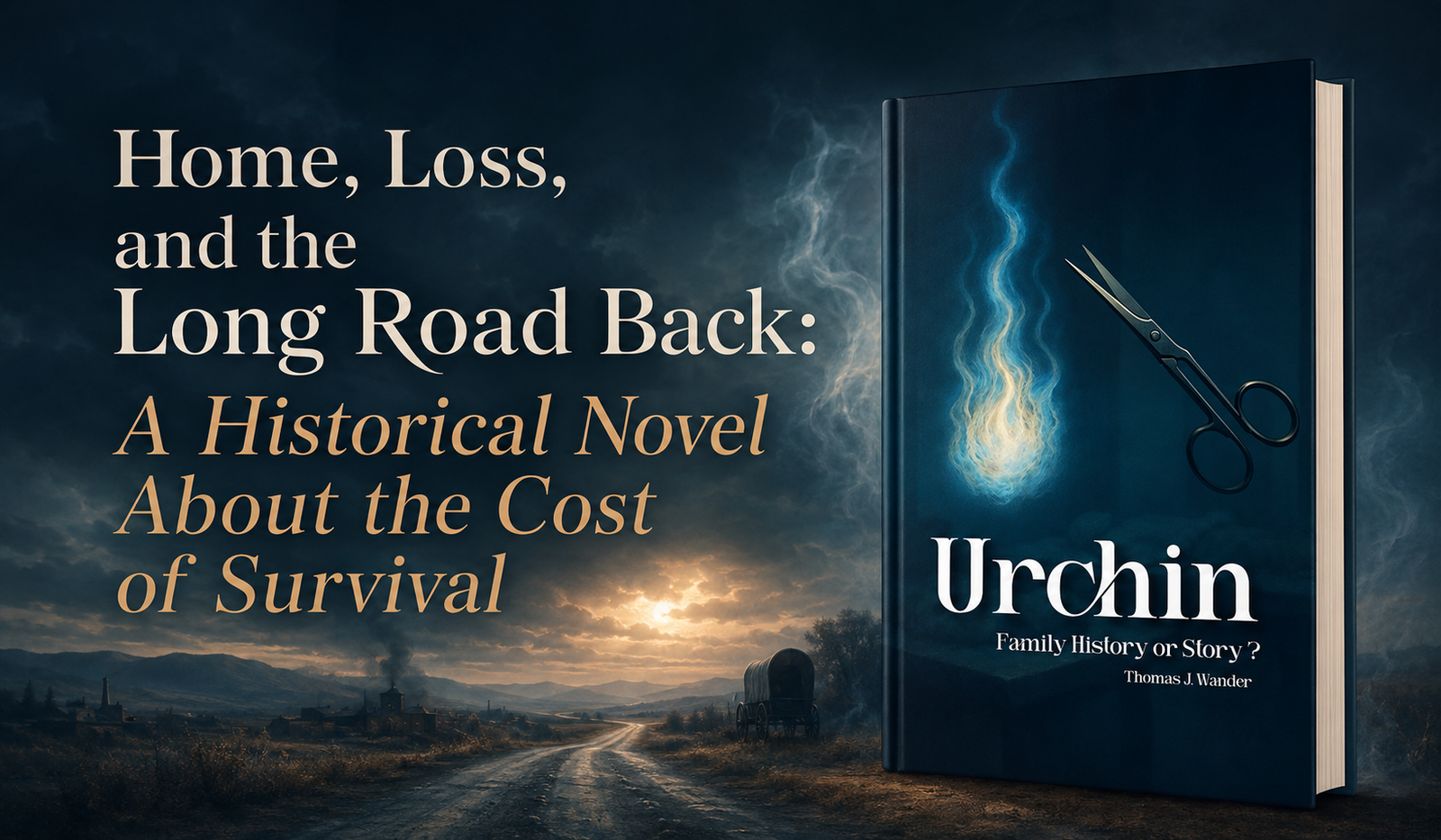
Home, Loss, and the Long Road Back: A Historical Novel About the Cost of Survival
Home is more than a place.
It is a collection of familiar voices.
A routine we rarely think about.
A sense of belonging that often goes unnoticed until it is gone.
Most people assume it will always be there.
Waiting.
Unchanged.
Ready to welcome them back.
But what happens when life takes someone so far from home that they begin to wonder whether they can ever truly return?
That question lies at the emotional center of Urchin: Family History or Story?, a compelling historical novel by Thomas J. Wander that explores survival, loss, identity, and the enduring human desire to find one's way back to where it all began.
Set during the upheaval of the Napoleonic era, the novel follows Johannes, a young Dutch apprentice tailor whose ordinary life is shattered when he is swept into circumstances beyond his control.
Separated from everything familiar, he embarks on a journey that will test not only his ability to survive, but also his understanding of who he is.
As the years unfold, Johannes faces challenges that transform him in ways he could never have imagined.
The road before him becomes longer than any physical distance.
It becomes a journey through hardship.
Through uncertainty.
Through experiences that leave lasting marks on both body and spirit.
Yet beneath every challenge remains a single, persistent hope.
Home.
It is a simple idea.
And one of the most powerful forces in human life.
Throughout history, countless people have been separated from the places they love by war, circumstance, economic hardship, or events beyond their control.
Some eventually return.
Others never do.
For those who survive long periods of absence, another question often emerges:
Will home still feel like home when they get there?
Wander explores this question with remarkable sensitivity.
Rather than treating survival as a purely physical achievement, Urchin examines its emotional consequences.
Every difficult experience changes Johannes.
Every loss shapes his perspective.
Every challenge leaves an imprint.
The person who hopes to return home is no longer the same boy who once left it behind.
This reality creates one of the novel’s most compelling tensions.
The farther Johannes travels, the more uncertain the idea of return becomes.
Not because home disappears.
But because people change.
Time passes.
Life continues.
The world does not stand still while someone is away.
Many readers will recognize this truth from their own lives.
A childhood home revisited years later often feels different.
The streets seem smaller.
The familiar places have changed.
The people who once filled our days have moved on, grown older, or disappeared altogether.
The memories remain.
But the experience is never exactly the same.
Urchin captures that emotional complexity beautifully.
The novel understands that returning home is rarely as simple as arriving at a destination.
Often, it requires reconciling who we once were with who we have become.
It requires accepting change while holding on to what matters most.
It requires courage.
This perspective gives the story a depth that extends beyond historical adventure.
While readers are drawn into Johannes’ experiences and the challenges he faces, they are also invited to reflect on their own understanding of home, belonging, and identity.
The novel asks questions that feel universal.
What do we carry with us when everything else is lost?
What parts of ourselves survive even after difficult experiences?
And what truly makes a place feel like home?
These themes resonate because they touch something fundamental in the human experience.
Everyone knows what it means to miss a place.
To long for familiarity.
To seek connection after a period of separation.
Whether the distance is measured in miles, years, or life experiences, the desire to return remains deeply human.
Wander also reminds readers that survival is rarely a solitary achievement.
Throughout Johannes’ journey, relationships play a vital role.
Acts of kindness matter.
Moments of compassion matter.
The people we encounter along the way often influence our futures in ways we cannot immediately understand.
These connections help shape the person Johannes becomes and provide some of the novel’s most memorable moments.
They also reinforce one of the book’s central ideas:
That even in the most difficult circumstances, humanity persists.
Hope persists.
The possibility of belonging persists.
Ultimately, Urchin: Family History or Story? is a story about far more than historical events.
It is a story about endurance.
About remembering where we come from.
About carrying pieces of home with us even when we are far away.
And about the extraordinary courage required to keep moving forward when the destination seems impossibly distant.
At its heart, the novel reminds readers that survival is not merely about staying alive.
It is about preserving the part of ourselves that still believes there is something worth returning to.
For more information about Urchin: Family History or Story? or to schedule an interview with Thomas J. Wander, please contact:
Media Contact:
Author: Thomas Wander
Amazon: Urchin: Family History or Story?
About Thomas J. Wander:
Thomas J. Wander is an author whose work draws upon family history, historical events, and the resilience of ordinary people facing extraordinary circumstances. Through richly human storytelling, he explores themes of identity, survival, belonging, and the lasting impact of the journeys that shape our lives.








0 Comments